
02 / Interstellar travel / the geometry of a shortcut
Wormholes: Could Spacetime Make the Universe Smaller?
The distances between stars turn exploration into a problem of lifetimes. A hypothetical wormhole asks whether the route itself could change, while leaving a traveler subject to the local speed of light. The equations open a question that nature has yet to answer.
A civilization could learn to cross its own planetary system and still face a Universe that refuses to fit inside a human lifetime. Improving a spacecraft helps, but distance remains part of every ordinary journey. Wormholes move the question into geometry: could two regions far apart along the familiar route also be connected by another passage? A useful investigation has to keep several ideas apart. A connection must exist, remain open, admit a traveler and produce the claimed timing advantage. Drawing the passage is the beginning of that argument, rather than its completion.
The problem is the journey, not only the engine
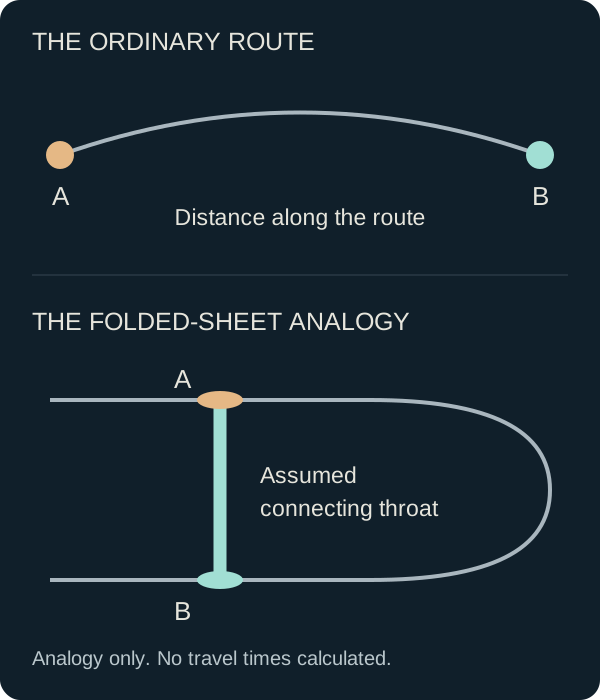
A light-year measures distance: the distance light covers in a year in vacuum. A destination a thousand light-years away therefore imposes a thousand-year light-travel time along an ordinary path in a simplified, stationary setting. A material spacecraft travels more slowly along that same path. Relativistic motion can reduce the elapsed time experienced by its crew compared with clocks at rest along the route, but it does not make those distant clocks agree that the ship arrived ahead of light. A spacetime shortcut asks a different question about which paths are available.
Morris and Thorne (1988): Wormholes in spacetime and their use for interstellar travelWhat the folded-paper picture gets right
Put A and B far apart on a sheet, fold the sheet, and their marks can appear close in the surrounding room. The analogy helps distinguish the distance along a surface from another possible connection. It does not show that our three-dimensional space is a sheet embedded in a room, that bending a sheet creates a hole, or that an extra dimension is a required construction material. A wormhole is described by its spacetime geometry and connections. The throat in the drawing stands for an assumed passage, whose existence and properties require a physical theory.
Morris and Thorne (1988): Wormholes in spacetime and their use for interstellar travelA wormhole has to remain a passage
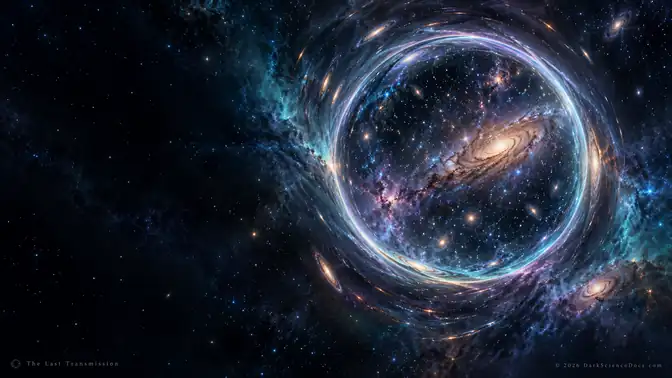
A traversable wormhole must provide a route that matter or signals can actually follow between its mouths. The familiar bridge associated with the idealized eternal Schwarzschild black-hole solution is not a usable two-way tunnel. Nor does the observation of a black hole establish a hidden exit. A travel proposal must examine horizons, the throat’s behavior and forces across a traveler’s body. The glowing doorway in the artwork is invented visual context. It is not an observation or a calculation of how a real wormhole would appear.
The difficult part is what supports the throat
For familiar static traversable-wormhole constructions in ordinary general relativity, the required stress-energy violates a classical null energy condition. This is a statement about energy density and stresses measured along lightlike directions. Quantum fields can produce negative renormalized energy in specific settings, but the amount, duration and distribution cannot simply be chosen freely. Ford and Roman’s analysis placed severe constraints on several static geometries under stated quantum-field assumptions. It is a substantial obstacle, rather than a universal proof about every possible theory of gravity. A supply of ordinary antimatter is not the exotic stress-energy assumed in these constructions.
Ford and Roman (1996): Quantum field theory constrains traversable wormhole geometriesWhose clock says the trip was short?
Traversable does not automatically mean a faster arrival than light traveling outside. Maldacena and Milekhin studied humanly traversable configurations using additional physics beyond the Standard Model. Their example can allow very little proper time to pass for a traveler while much more time passes for observers outside. They explicitly distinguish this from an external-time shortcut. This matters whenever a headline promises a journey across the galaxy in seconds: one must ask which clock measures those seconds, what model is assumed, and whether the destination is reached sooner according to the surrounding Universe.
Maldacena and Milekhin (2021): Humanly traversable wormholesA doorway does not explain how to place its far end
Even granting a suitable geometry, a civilization would need access to both mouths and a history explaining how the configuration came to exist. A diagram that begins with one mouth beside Earth and the other near a distant star has already assumed away much of the exploration problem. There is no established method for manufacturing a traversable wormhole or selecting an arbitrary destination. Proposals involving pre-existing structures, moving mouths or additional fields must be judged within their own assumptions, including the stability of the structure during the procedure.
Wormhole, warp bubble and Krasnikov tube are different ideas
A wormhole supplies an additional connection between regions. Alcubierre’s original construction instead changes the spacetime geometry around a moving region, without introducing a wormhole. Krasnikov examined changes along a route and the distinction between an outward trip and a round trip. Neither should be treated as another name for a portal. These mathematical proposals ask related questions about travel but have different geometries, causal structures and matter requirements. Comparing them is useful precisely because a success or limitation in one construction cannot simply be transferred to the others.
A shortcut can become a question about causality
If a traversable connection could provide the appropriate kind of shortcut, changing the relative timing of its mouths can create scenarios with closed timelike curves: paths that return to an earlier event in the external description. Morris, Thorne and Yurtsever explored this connection between wormholes and time machines. It does not show that time travel is possible in nature. It shows why checking a travel proposal requires examining the complete spacetime and its history. Quantum effects and the consistency of causality remain central to the unresolved question.
Morris, Thorne and Yurtsever (1988): Wormholes, time machines, and the weak energy conditionA quantum experiment did not open a doorway
The 2022 quantum-computer experiment associated with wormhole dynamics implemented a quantum system used to study a theoretical correspondence. Caltech explicitly distinguished that result from creating an actual wormhole in spacetime. Such work can illuminate connections between quantum information and gravity without transporting a spacecraft or a person through a tunnel. The durable question is whether a mathematically interesting connection can correspond to a physically realizable spacetime. A diagram, a quantum-model experiment, a consistent solution and a built passage are different stages of evidence.
Caltech: what the quantum-computer wormhole experiment actually demonstratedThe companion Substack article compares warp drives and Krasnikov tubes. They are distinct proposals, and provide context for the wormhole question explored on this page.
Compare the spacetime-shortcut proposals on SubstackTHE EVIDENCE / THE OPEN QUESTION
What we know.
General relativity provides a language for describing curved spacetime. Physicists have constructed hypothetical traversable-wormhole models and studied the matter and quantum effects they require. No traversable wormhole has been observed or built; a mathematical spacetime is not a demonstrated transport system.
What remains open.
It is unresolved whether nature permits a macroscopic wormhole that could be created, stabilized and used as an interstellar shortcut. Energy conditions, quantum constraints, tidal forces, formation, control and causality must all be addressed. Some traversable models do not provide faster arrival for outside observers.
Why it matters.
A doorway would change which places can be reached and when information can arrive. That makes the difference between a shorter route, a shorter experience for a traveler, and an earlier arrival in the surrounding Universe essential. These proposals are powerful ways to ask what spacetime permits, even while no engineering path is established.
WATCH THE DOCUMENTARY
The Complete Guide to Spacetime Shortcuts: The Krasnikov Tube vs Alcubierre Drive
Two general-relativity constructions explore apparent faster-than-light journeys. Neither is a built or demonstrated propulsion system.
COMPARE THE QUESTIONS
Keep the different geometries in view.
Explore measured bending of light, a black-hole teaching model, and the scale of signal delays. These experiences illustrate related concepts; they do not generate or demonstrate a traversable wormhole.
FOLLOW THE EVIDENCE
Research behind the field note.
FOLLOW THE THREAD
Related signals.
A Star Blinked Twice. Whatever Caused It May Be Much Closer to Earth.
Two nearly identical optical disturbances, 4.4 seconds apart, appeared in HD 89389’s light. Follow the unexplained record, a foreground diffraction hypothesis, and the synchronized telescopes proposed to test it.
What If the Universe Is Accelerating Because Stars Die?
For nearly three decades, scientists have struggled to identify the mysterious force accelerating the expansion of the universe. Now a radical theory suggests the answer.
A Star Died 6.5 Billion Years Ago. Its Explosion Is About to Arrive Again.
NASA is watching for a supernova we have already seen. When that light finally reaches Earth, it could help answer one of the most troubling questions in modern cosmology.