DOCUMENTARIES / THE LAST TRANSMISSION
The Man Who Waited 60 Years to Touch the Sun | Eugene Parker
Eugene Parker predicted the solar wind long before a spacecraft could follow it into the Sun’s atmosphere.
If the player is unavailable, watch directly on YouTube ↗
THE QUESTION BEHIND THE FILM
What does it take for an idea rejected on paper to become a journey into a star?
ORIGINAL VIEWING GUIDE
Look closer.
A prediction before the probe
Parker’s 1958 work described a constant flow of charged particles from the Sun. Later spacecraft observations established the solar wind, turning a controversial theoretical argument into a measurable part of space weather.
The corona is not a landing place
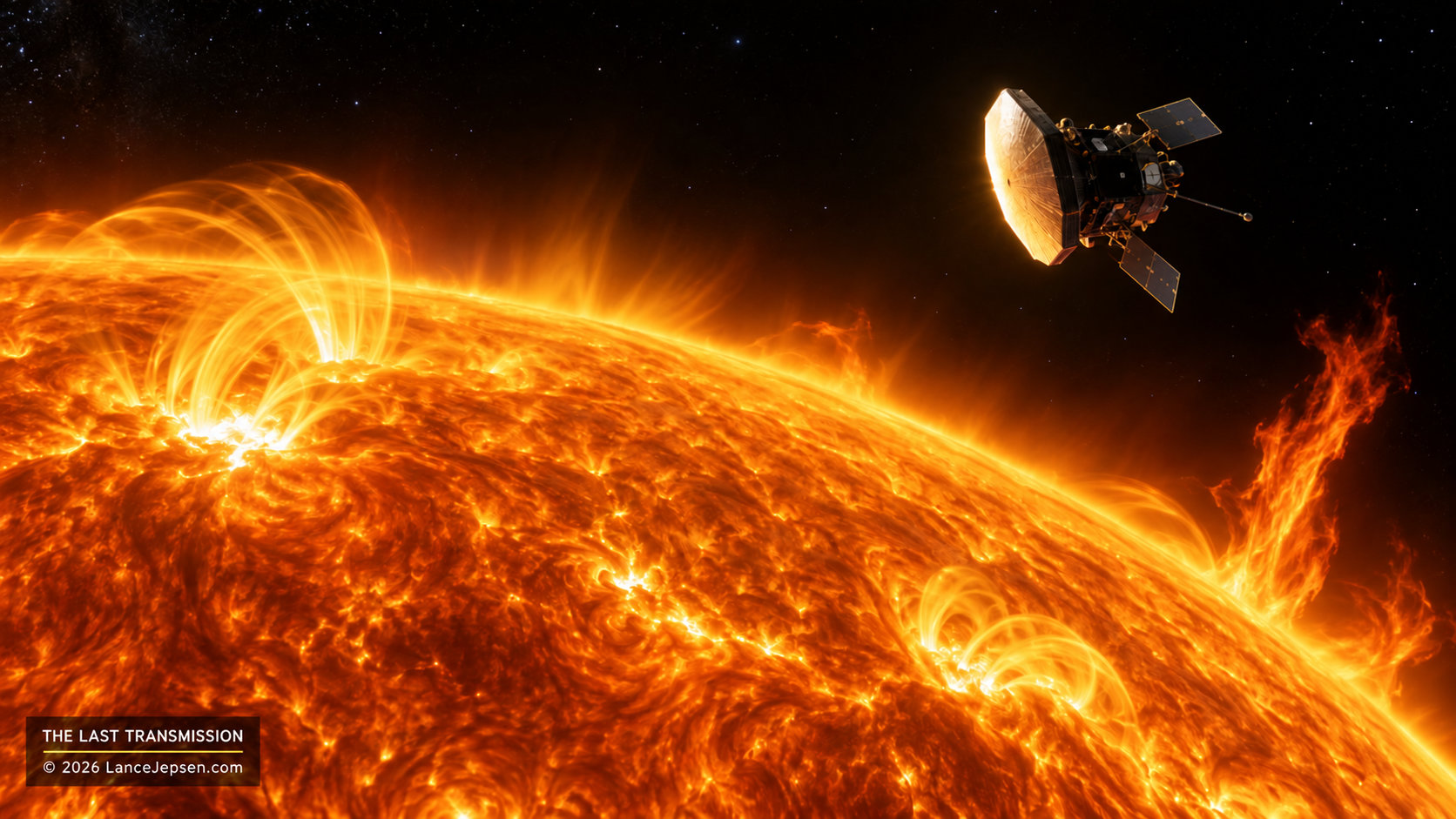
Parker Solar Probe studies the Sun’s outer atmosphere by repeatedly flying close to it. Its heat shield protects the instruments while they sample the environment that accelerates the solar wind and heats the corona.
The human scale of a long experiment
The mission was named for Parker while he was alive. He saw his namesake spacecraft launch and enter the solar atmosphere, but its observations continue beyond his lifetime. The film follows the scientist alongside the machine.
THE EVIDENCE TRAIL / RESEARCH COMPANION
What the record says.
The story connects a theoretical prediction with measurements made decades later. Parker predicted a wind from the Sun; a spacecraft bearing his name eventually measured the environment where that wind becomes free to travel outward.
CHOOSE A CLUE / FOLLOW THE RECORD
These are research waypoints, not video timestamps. Explore them in any order, then return to the film.
The wind began as a prediction
Observed or documented
In 1958 Eugene Parker published a model of continuously expanding solar plasma. Subsequent spacecraft measurements confirmed a solar wind flowing through interplanetary space. Parker lived to see a mission named for him launch in 2018.
What it suggests
A physical model can make a surprising, testable prediction before an instrument can go where it matters most. Later confirmation does not mean the first model contained a complete account of every source and variation of the wind.
Where the claim stops
The decades-long narrative is a history of prediction, testing, and revision, not a claim that every modern heliophysics question was settled in 1958.
The probe crossed a physical boundary
Observed or documented
During an April 2021 encounter, Parker Solar Probe passed into the solar corona and sampled particles and magnetic fields there. NASA announced the first crossing that December. The boundary is associated with the Alfvén critical surface, where outflow changes its relationship to the Sun.
What it suggests
'Touching the Sun' means entering its outer atmosphere and measuring plasma in place. It is a physical milestone, but it is not landing on a solid surface or collecting a piece of the Sun.
Where the claim stops
The crossing was not a simple spherical line: the probe moved into and out of the region, revealing a structured boundary rather than a fixed shell at one altitude.
The closest pass pushed the measurements inward
Observed or documented
On December 24, 2024, NASA reported a closest pass about 3.8 million miles above the Sun's surface and a speed near 430,000 miles per hour. These figures describe a flyby, with a heat shield protecting the spacecraft's instruments.
What it suggests
Closer in-situ observations reduce how much scientists must extrapolate backward from measurements near Earth. Repeated passes provide opportunities to compare local plasma conditions with changes in the surrounding corona.
Where the claim stops
A closest-approach record is not itself an answer to why the corona is so hot. Its scientific value comes from the measurements and their comparison with physical models.
The solar wind still has open physics
Observed or documented
The probe found sharp reversals in the Sun's magnetic field called switchbacks. Later images and particle measurements help trace how flows and magnetic structures develop near the corona.
What it suggests
Researchers investigate whether these structures help explain the acceleration of portions of the solar wind. The data constrain models of how energy and plasma escape from the Sun into the heliosphere.
Where the claim stops
A mechanism for one component of the wind need not explain every slow- and fast-wind stream, every switchback, or the broader coronal-heating problem.
Which processes heat the corona and accelerate the different streams of solar wind, and how do direct measurements near the Sun change those models?
EXPLORE IN 3D / MAP 03
Follow Parker into the corona
Turn toward the Sun and open the Parker file on the solar wind, the probe, and the evidence behind the film.
Open Sun mapFOLLOW THE EVIDENCE
Keep the question open.
Watch the documentary, check the research, and continue into the illustrated archive.
MORE DOCUMENTARIES
 The Promise That Came Home: NASA’s Mission to Asteroid Bennu
 Nancy Grace Roman: The Woman Who Made Hubble Possible
 Voyager 1 Is Going Dark: NASA’s 2026 Mission Status