
99 / COSMIC MYSTERIES / FIELD NOTE
The Knots Around the Survivor of 1181
Follow Pa 30’s resolved knot chains, its central remnant and the historical records that connect a modern nebula with the guest star of 1181.
An old record becomes a physical investigation
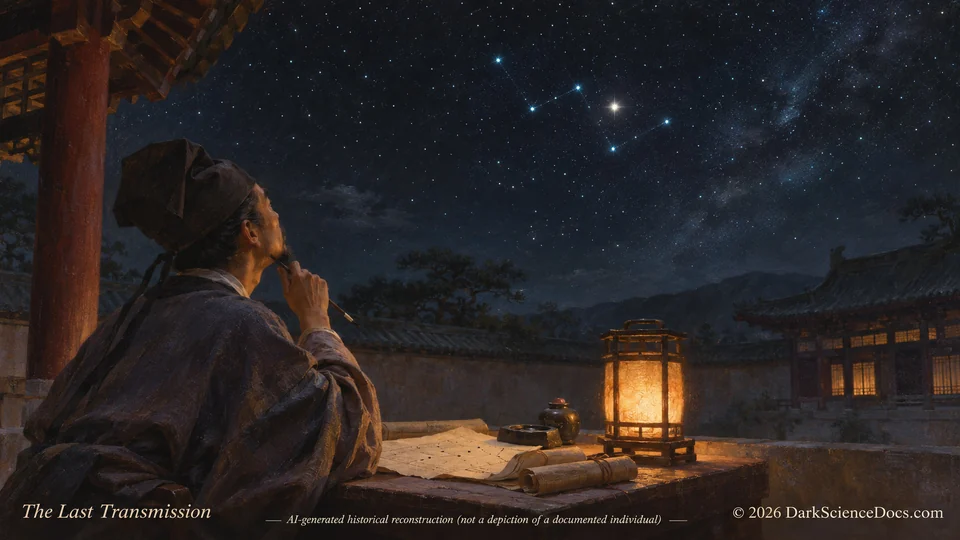
Observers in 1181 recorded a guest star that remained visible for months. Their accounts preserve an appearance in the sky without providing the images and spectra that astronomers would want today. Connecting that event to a surviving remnant requires an argument built from location, age, expansion and the properties of the material left behind.
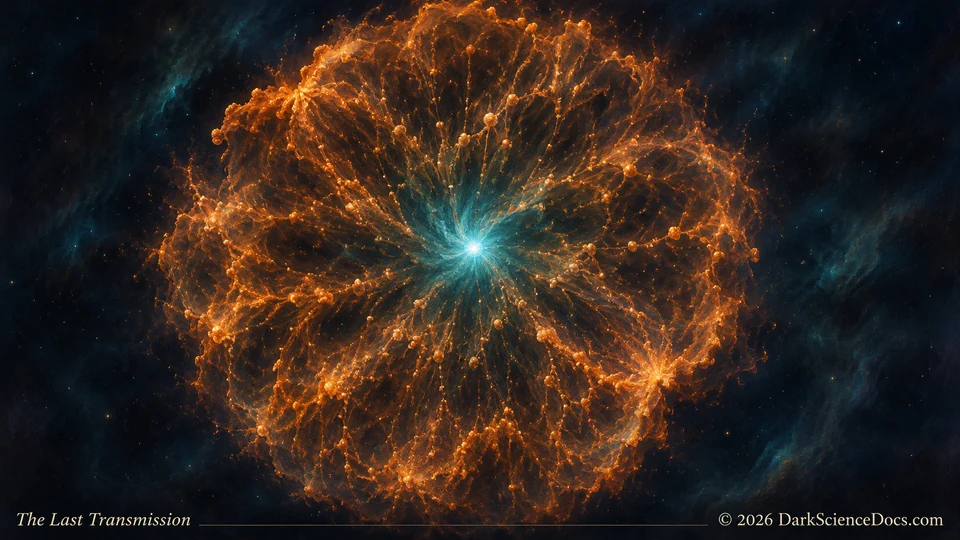
Pa 30 is the favored candidate. Discovered in archival infrared material in 2013, it contains a central hot object surrounded by an extraordinary radial network of filaments. The system lets researchers compare a historical record with a physical aftermath rather than leaving the guest star solely within the chronicles that described it.
A filament becomes a chain of knots
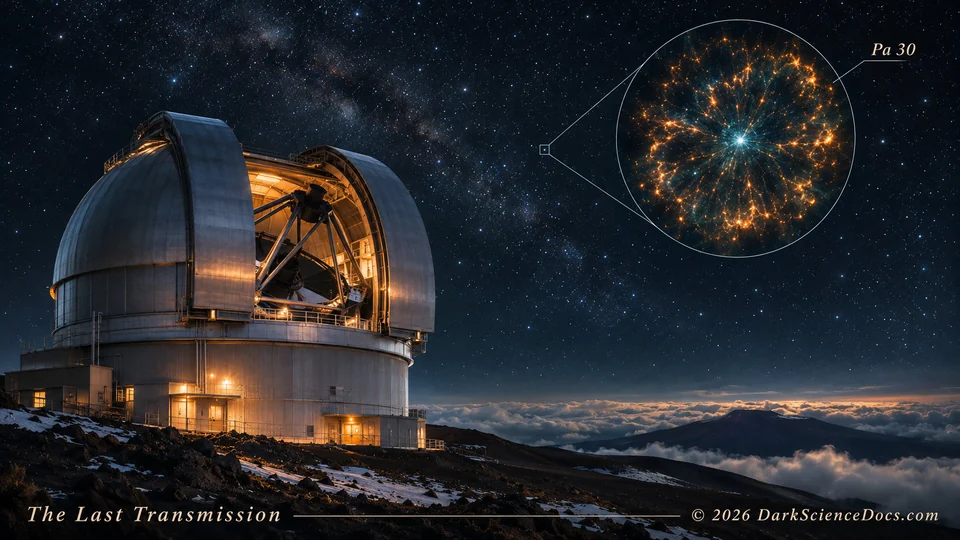
Gemini North observations with the Gemini Multi-Object Spectrograph reveal finer structure within Pa 30’s outward-reaching filaments. What had looked like comparatively smooth streaks resolves into chains of bright knots. That change in detail adds information about how the expanding material interacts with the environment through which it travels.
The knots are measured structures; their formation history must be inferred. Variations in density or thermal conditions around the explosion could have shaped the ejecta. Comparing those possibilities requires the distribution, motion and emission of the gas, alongside models that explain why a particular pattern would develop.
A surviving center makes the explosion unusual
A hot central object remains within Pa 30. Its presence fits an interpretation in which the event did not completely disrupt the compact stellar system. Researchers associate the remnant with a rare Type Iax thermonuclear explosion, a category whose models can leave a gravitationally bound survivor after ejecting part of the material.
That outcome deserves a careful description. A star surviving its own supernova is a compelling shorthand for an inferred explosion history. The central object is not an untouched version of its earlier self, and its existence does not make every detail of a particular white dwarf interaction or burning scenario directly observable.
The center constrains the motion
The surviving object lies close to the center of the surrounding remnant. A large kick would tend to move a survivor away from that position over time, so the geometry constrains some possible explosion outcomes. The measured arrangement helps researchers assess how symmetrical the event may have been.
This reasoning connects the star and the shell. An image becomes more informative when its physical scale, age and motion are considered together. A centered star alone would not reconstruct the explosion; its position gains meaning through the wider evidence about the expanding gas and the system’s history.
Read the aftermath in layers
Begin with the Gemini observations, then separate the conclusions drawn from them. The knot chains, central object and remnant geometry are evidence to compare with an incomplete thermonuclear explosion. The association with SN 1181 adds a historical anchor, while remaining a carefully supported identification rather than a photograph of the original event.
An artistic reconstruction can make the medieval sky or the hidden explosion imaginable. It should keep those scenes apart from telescope data and avoid presenting a speculative interior as an observed cutaway. The most interesting survivor is the one whose unusual history can still be tested, one measured structure at a time.