
56 / The colors of missing light
The Test That Changed Tabby's Star
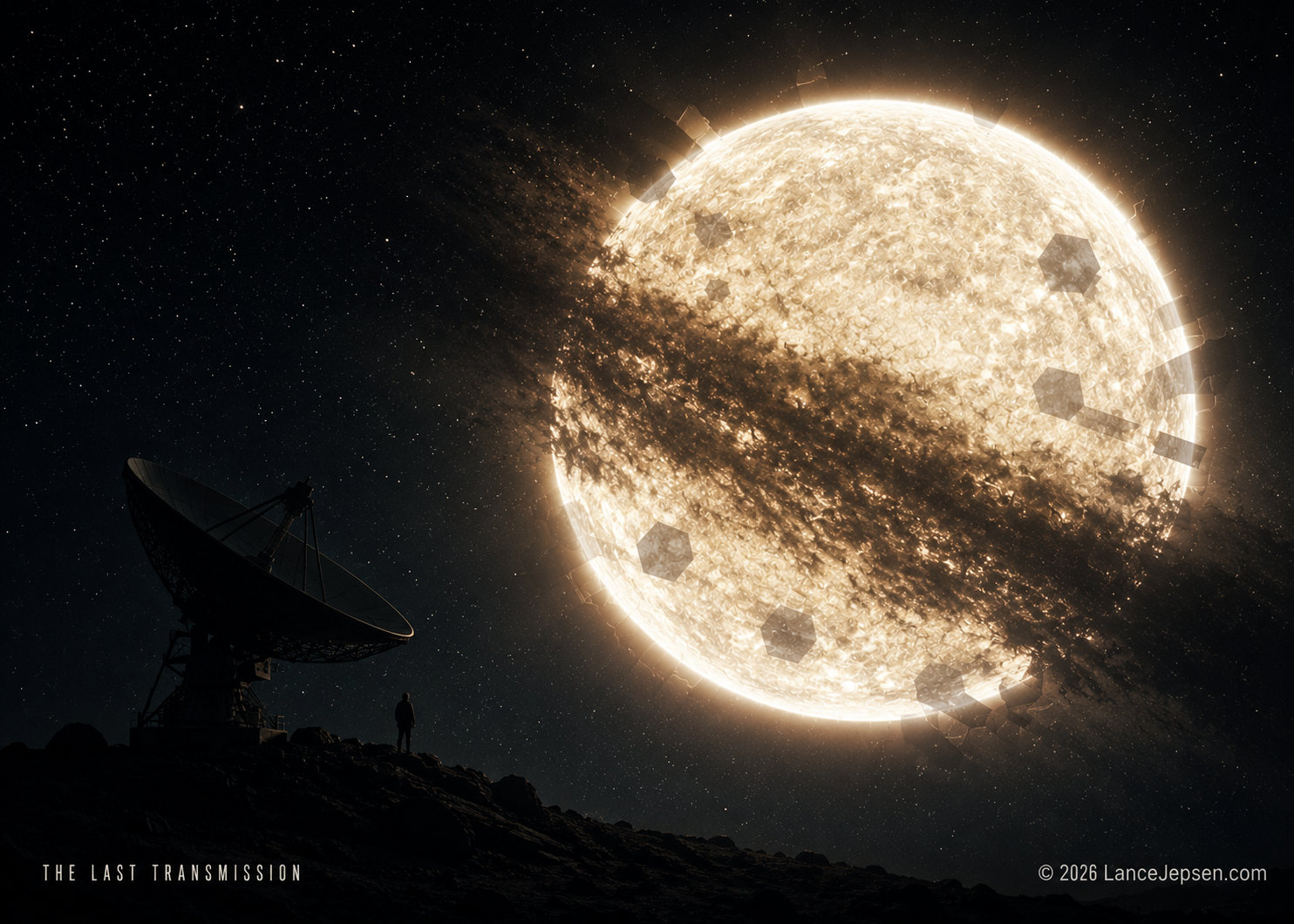
Kepler measured startling, irregular dips in KIC 8462852. Watching how the star dims at different wavelengths helps test what blocked its light and narrows the room for a solid opaque structure.
The light curve alone gives a dramatic silhouette without identifying the blocker. A solid object large enough to cover part of the star would generally dim the observed light in a less wavelength-dependent way than very small dust particles. Later observations found that some longer-term dimming was weaker in infrared and stronger at shorter wavelengths, a pattern compatible with fine dust. That does not put a camera beside the star or settle every dip with one tidy ring. It changes which explanations survive an independent measurement.
The full investigation continues with the evidence, illustrations, and sources at The Last Transmission on Substack.
Continue reading on SubstackTHE EVIDENCE / THE OPEN QUESTION
What we know.
NASA's Kepler mission recorded unusual and sometimes deep drops in the star's brightness. Subsequent multiwavelength observations reported a color dependence for longer-term dimming, supporting dust as an explanation for at least part of the behavior.
What remains open.
The location, composition, and geometry of the obscuring material remain matters of study, and different timescales need not have a single cause. The data do not establish an engineered megastructure or an alien transmission.
Why it matters.
The episode is a model of scientific investigation: a captivating pattern becomes more useful when an instrument asks a discriminating question. The colors of the missing light matter more than the most cinematic silhouette.
GO DEEPER / EVIDENCE FILE
What Does Tabby’s Star’s Light Curve Actually Reveal?
Inspect actual Kepler samples from two dimming episodes, then follow the separate color measurements that helped test explanations for KIC 8462852.
FOLLOW THE EVIDENCE
Research behind the field note.
FOLLOW THE THREAD
Related signals.
A Star Blinked Twice. Whatever Caused It May Be Much Closer to Earth.
Two nearly identical optical disturbances, 4.4 seconds apart, appeared in HD 89389’s light. Follow the unexplained record, a foreground diffraction hypothesis, and the synchronized telescopes proposed to test it.
What If the Universe Is Accelerating Because Stars Die?
For nearly three decades, scientists have struggled to identify the mysterious force accelerating the expansion of the universe. Now a radical theory suggests the answer.
A Star Died 6.5 Billion Years Ago. Its Explosion Is About to Arrive Again.
NASA is watching for a supernova we have already seen. When that light finally reaches Earth, it could help answer one of the most troubling questions in modern cosmology.