
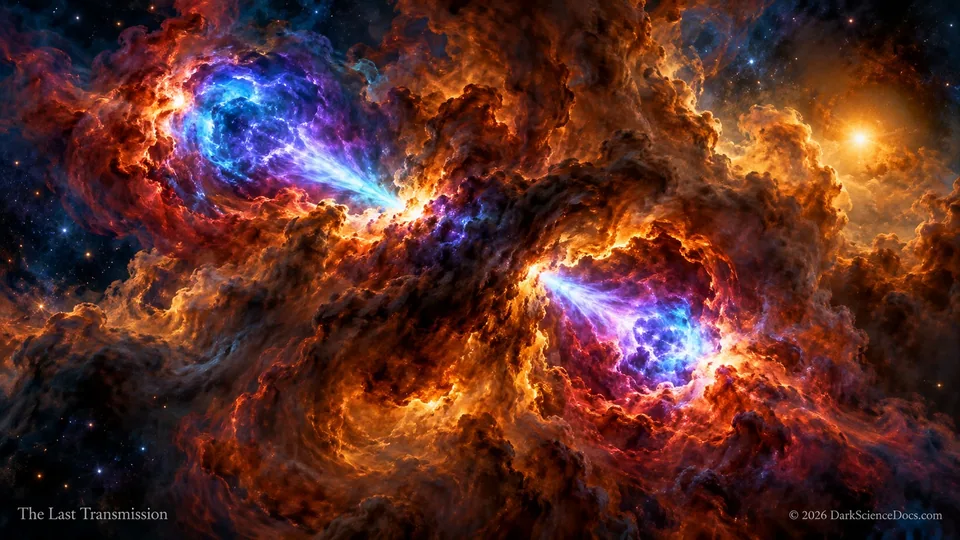
15 / VT J1906+0849 / an unclassified transient
The Compact Radio Engine That Refuses a Simple Identity
An unusually luminous, slowly changing Galactic radio source may be powered by a compact accreting object hidden in dense gas. The proposal raises a population question, but one unclassified source cannot establish how many such engines exist.
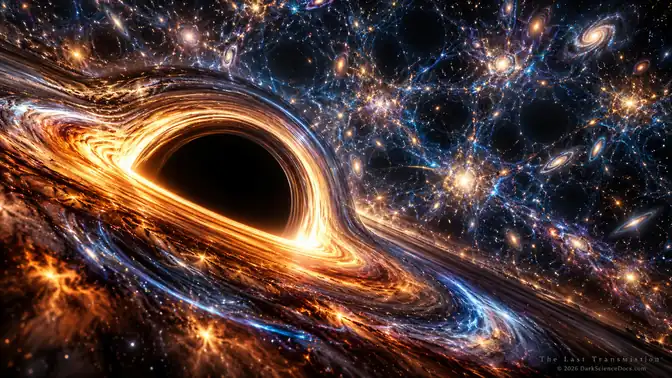
A comparison between radio surveys can reveal an object that changed dramatically while optical and X-ray searches supplied little explanation. VT J1906+0849 is difficult to fit into familiar categories because its radio power lasts while its emitting region shows unusually little expansion. A compact engine feeding energy into dense surroundings is one way to maintain that combination. The proposed microquasar interpretation connects accretion, outflows and a confining wind. Those structures are inferred from measurements and comparisons, rather than resolved into the complete system shown in a cinematic cutaway.
The full investigation continues with the evidence, illustrations, and sources at The Last Transmission on Substack.
Continue reading on SubstackTHE EVIDENCE / THE OPEN QUESTION
What we know.
The preprint reports a luminous Galactic radio transient evolving over decades, a compact radio region, an infrared emission feature and an X-ray nondetection. Sustained energy input is favored over a simple freely expanding explosion. An SS 433-like accreting system is a useful comparison, while the precise identity of the central compact object remains unresolved.
What remains open.
The source is not a confirmed black hole merely because a black-hole illustration accompanies the hypothesis. The infrared line interpretation, distance and surrounding gas affect the model. A population of obscured microquasars is a possibility to test through surveys; this object does not count that population. The checked research record remains a preprint.
Why it matters.
Objects that are conspicuous in one band and faint in another expose selection effects in our inventory of the Milky Way. Radio motion, harder X-ray observations and clearer infrared spectra can discriminate among interpretations. A surprising source becomes most useful when it supplies predictions for the next observation.
FOLLOW THE EVIDENCE
Research behind the field note.
EXPLORE IN 3D / MAP 12
Locate the wider Galactic setting
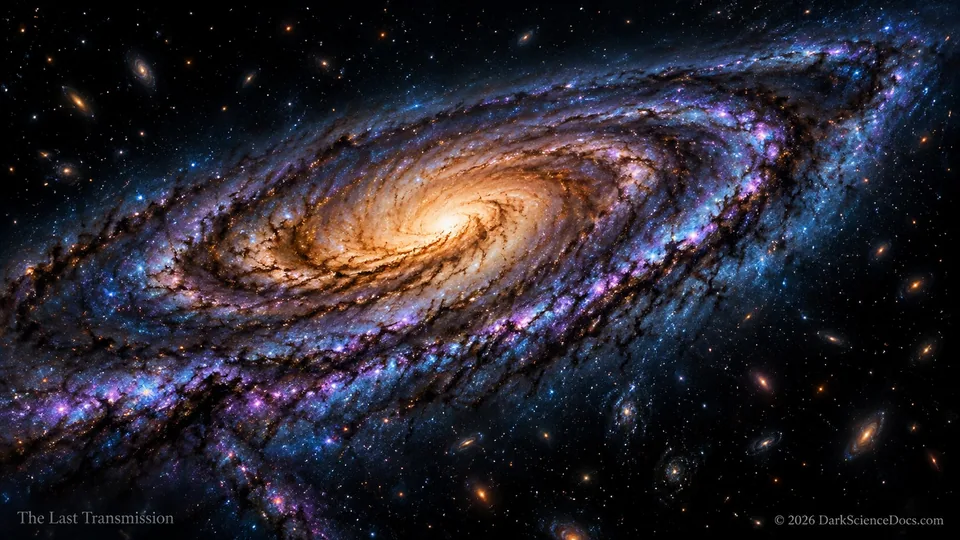
Explore an illustrative Milky Way map. It does not supply a measured source location or live Voyager position.
Open Milky Way mapVISUAL EVIDENCE
Inside the investigation.
FOLLOW THE THREAD
Related signals.
A Star Blinked Twice. Whatever Caused It May Be Much Closer to Earth.
Two nearly identical optical disturbances, 4.4 seconds apart, appeared in HD 89389’s light. Follow the unexplained record, a foreground diffraction hypothesis, and the synchronized telescopes proposed to test it.
What If the Universe Is Accelerating Because Stars Die?
For nearly three decades, scientists have struggled to identify the mysterious force accelerating the expansion of the universe. Now a radical theory suggests the answer.
A Star Died 6.5 Billion Years Ago. Its Explosion Is About to Arrive Again.
NASA is watching for a supernova we have already seen. When that light finally reaches Earth, it could help answer one of the most troubling questions in modern cosmology.