
COSMIC MYSTERIES / AI-GENERATED SCIENTIFIC ART
The Starship’s Shorter Clock Reading
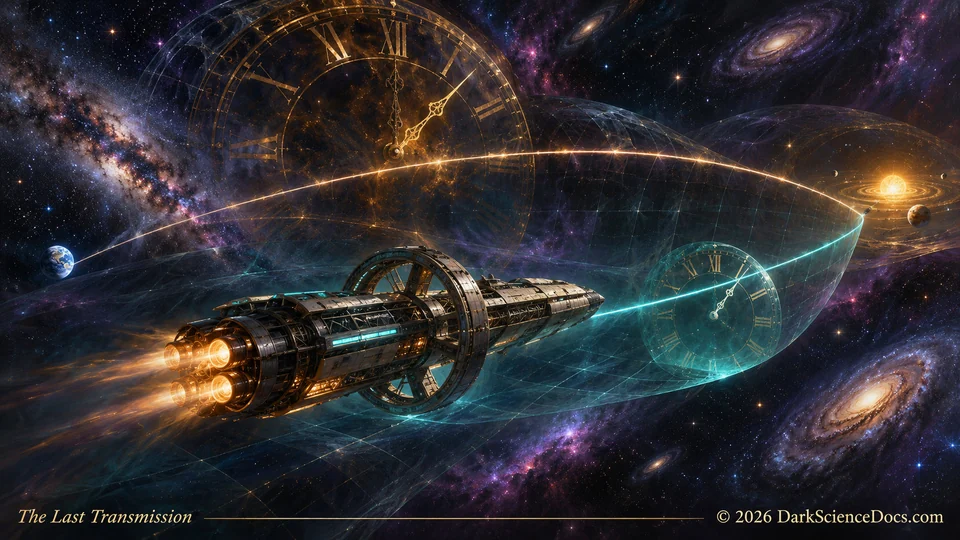
A hypothetical spacecraft traveling at 99.99 percent of light speed could cross a thousand-light-year distance in approximately fourteen years of onboard time, while roughly a thousand years pass in the reference frame of Earth and the destination. The example assumes an idealized journey with negligible acceleration and deceleration periods. © 2026 DarkScienceDocs.com
THE OBSERVATION
What the evidence can show.
An idealized ship traveling close to light speed can accumulate much less proper time than clocks in the departure-and-destination frame. The comparison depends on the chosen speed, distance and journey, including how acceleration is treated. Differential aging is a comparison of clocks, not evidence that the crew experiences its own local time running unusually slowly.
THE ILLUSTRATION
What the artwork imagines.
The starship, curved surfaces and large clock turn an idealized journey into a cinematic scene. They are not a spacecraft design, an observed voyage or a prediction of exactly what a window would show. The artwork does not depict measured acceleration or fuel requirements. Its purpose is to contrast accumulated clock readings while leaving the specified physics model explicit.
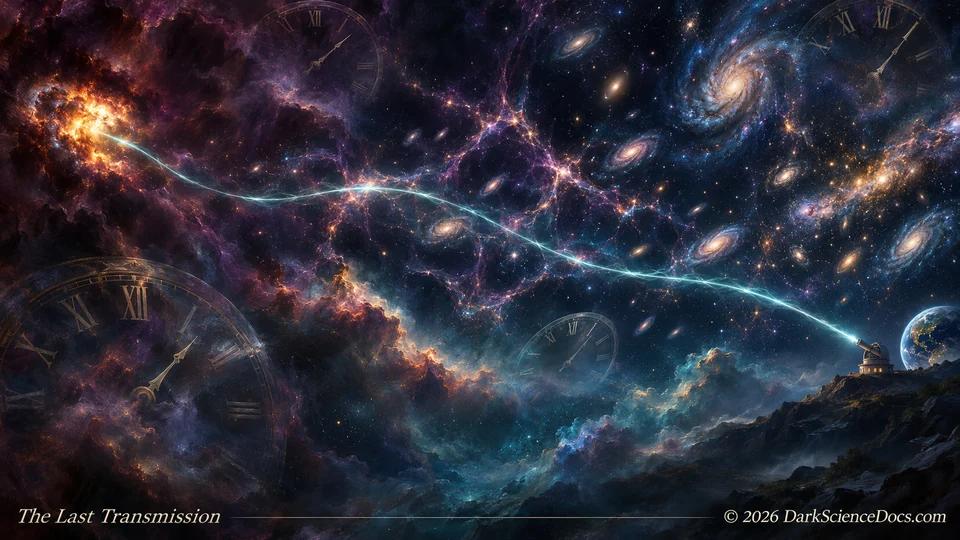 A Lightlike Path Across Cosmic History
 The Clock the Universe Does Not Share
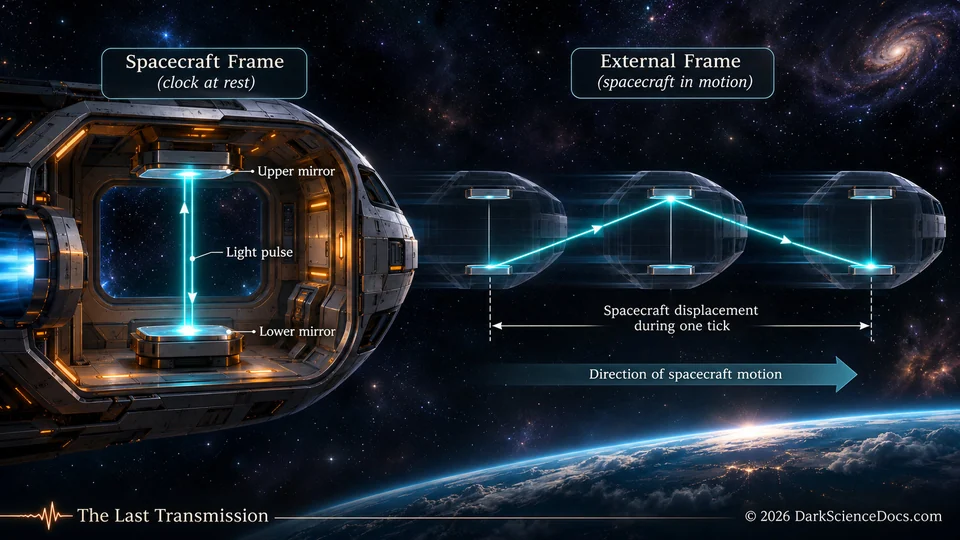 One Light Clock, Two Descriptions