
COSMIC MYSTERIES / AI-GENERATED SCIENTIFIC ART
One Light Clock, Two Descriptions
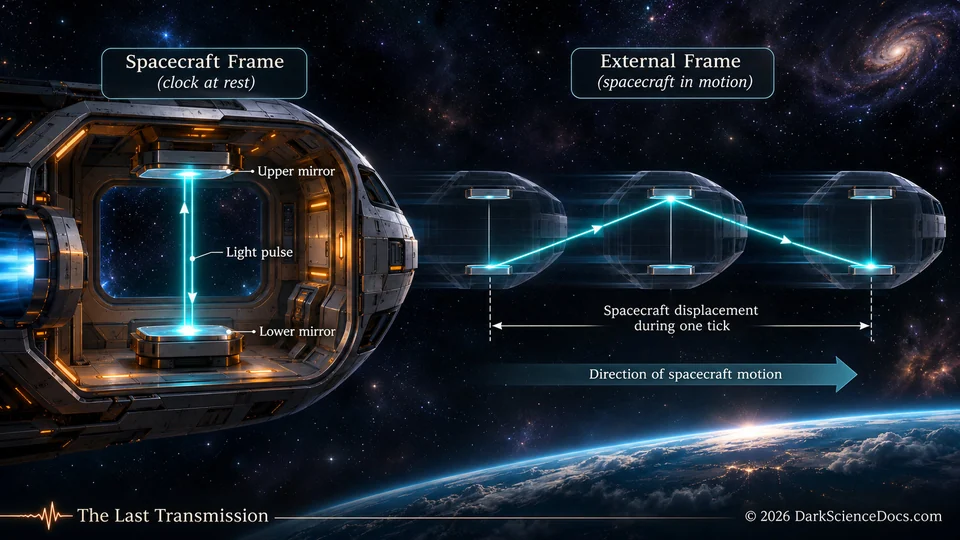
Einstein’s light-clock thought experiment reveals how observers moving relative to one another can measure different elapsed times. Because the speed of light remains constant, the longer path seen by an external observer corresponds to a longer interval between the clock’s ticks. © 2026 DarkScienceDocs.com
THE OBSERVATION
What the evidence can show.
A light clock provides a thought experiment for comparing inertial descriptions of the same pair of ticks. A moving observer can assign a longer light path and a longer interval while retaining the same speed of light. The comparison requires clearly defined frames. It does not mean that either observer sees light locally travel at a different speed.
THE ILLUSTRATION
What the artwork imagines.
The two spacecraft views and labeled rays are schematic teaching devices rather than photographs of a physical instrument. The paths emphasize the comparison between frames, while the spacecraft, mirrors and cosmic setting are illustrative. Distances and viewing geometry are not to scale. The diagram does not establish a photon’s own frame; it compares descriptions made by observers with clocks.
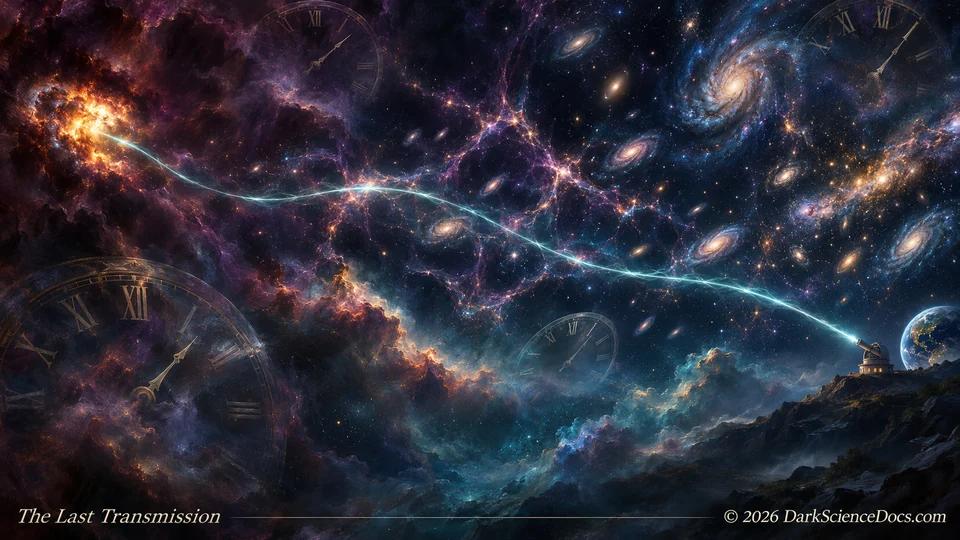 A Lightlike Path Across Cosmic History
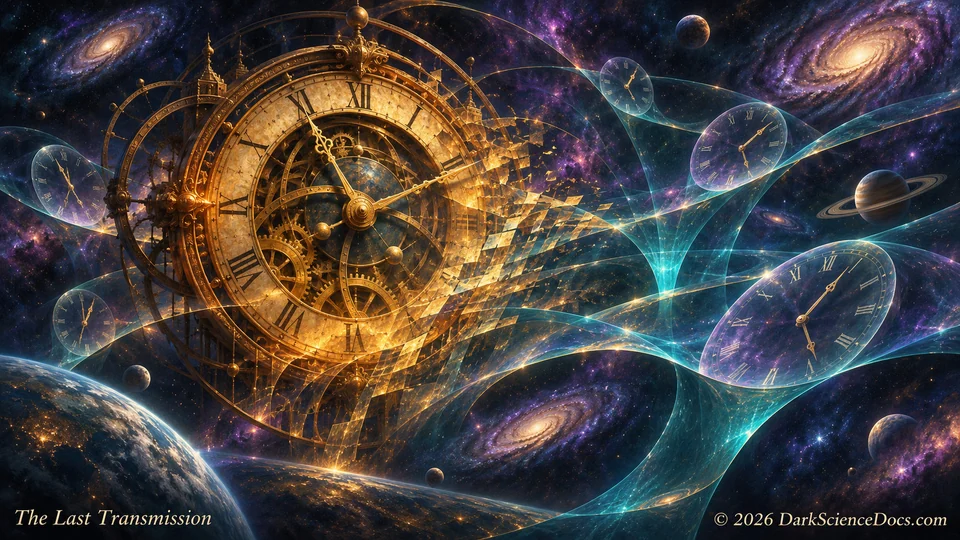 The Clock the Universe Does Not Share
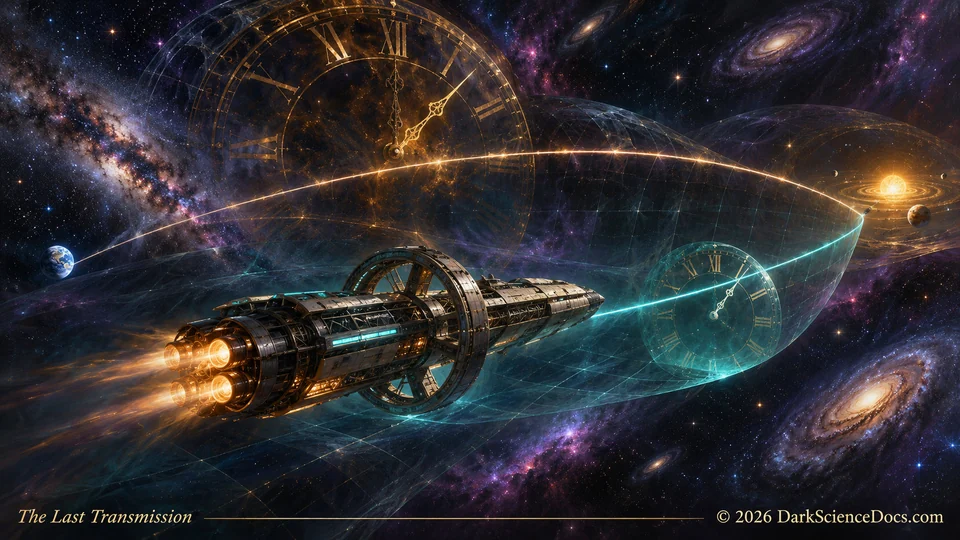 The Starship’s Shorter Clock Reading