
A SCIENCE EXPEDITION / 3 CHAPTERS / 8 STOPS
After the Sky Fell
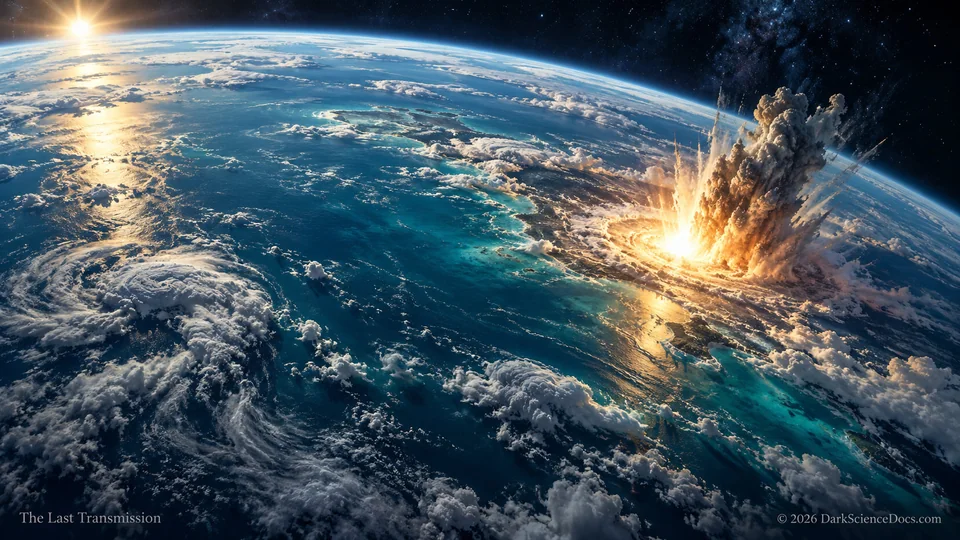
How can an impact destroy ecosystems and leave a different kind of habitat behind?
Follow the catastrophe into the fossil and mineral records, then carry the question to Mars. Keep the survival of organisms, the recovery of ecosystems and the origin of life separate as you go.
90–150 minutes, across several visits. No deadline; each chapter is a natural place to pause.
Your next step
0 of 8 stops completed
Use “Mark this stop complete & continue” when you are ready to move on. Visiting a page alone never marks it complete.
EXPEDITION COMPLETE
You followed the evidence.
Which evidence establishes destruction, which supports a later habitat, and what additional observation would be needed to argue that organisms were present?
Your completion marks record your journey, not a qualification or a test score. Revisit any stop below, or choose another expedition.
Choose another expedition →Chapter 1 · Follow the catastrophe
- 01
Documentary
Watch the world change
Ready to exploreWatch the film, then use its viewing guide to separate the immediate impact, the food-web crisis and later recovery. Which proposed survival advantages depend on the setting?
- 02
3D Atlas
Put the event on a planetary stage
Ready to exploreUse the illustrated Earth and Moon view to place impacts within planetary history. This is a context model, not a reconstruction of the Chicxulub collision.
Chapter 2 · Read what the rocks kept
- 03
Investigation
Follow the chain after the impact
Ready to exploreTrace the sequence from lost sunlight to survivors, recovery and cooling crater environments. Identify where an observation gives way to a model or a wider inference.
- 04
Evidence File
Separate a habitat from its inhabitants
Ready to exploreCompare hydrothermal duration, sulfur isotope interpretation and Martian mineral alteration. Which measurement supports each claim, and what would go beyond it?
- 05
Evidence File
Compare a different crater record
Ready to exploreFollow Hapcheon’s impact evidence, later lake layers and geochemical interpretation. Keep this younger lake setting distinct from Chicxulub’s cooling hydrothermal system.
Chapter 3 · Carry the question to another world
- 06
3D Atlas
Look at Mars in planetary context
Ready to exploreExplore the illustrated planet and its geological variety. This Atlas does not recreate Ritchey crater’s measured mineral map or show evidence of Martian organisms.
- 07
Investigation
Ask the harder origin question
Ready to exploreExamine possible early-Earth chemical refuges. Why would a model of favorable conditions, or later life in a crater, fall short of locating the origin of life?
- 08
Image story
Write a careful caption for the last world
Ready to exploreInspect the imagined exoplanet. Use the earlier records to write one supported claim, one inference and one open question. What must the artwork’s caption avoid implying?
Manage saved progress
Clear this expedition’s progress in this browser. Your science mystery casebook stays separate.
Clear these completion marks? This cannot be undone.
All stops are available now. Calendar reminders help you return; they do not unlock new content. Progress is saved in this browser when storage is available.