Voyager crossed the dark. It found a changing storm, faint rings, and a moon throwing material into its sky. Follow the images to the edge of what we know.
Choose a file. Drag to look around; pinch or use the zoom buttons.
FILE 01 / NEPTUNE–TRITON
Neptune
The distant ice giant
What can we know about a world visited once?
Voyager 2 passed Neptune in August 1989. Later telescopes continue watching the changing atmosphere from far away. The blue globe in this viewer uses a representative JPL/Don Davis cloud texture made for 3D display; its swirls are fictional, not a current weather map or a Voyager mosaic. The planet’s blue appearance is associated with methane absorption and atmospheric scattering.
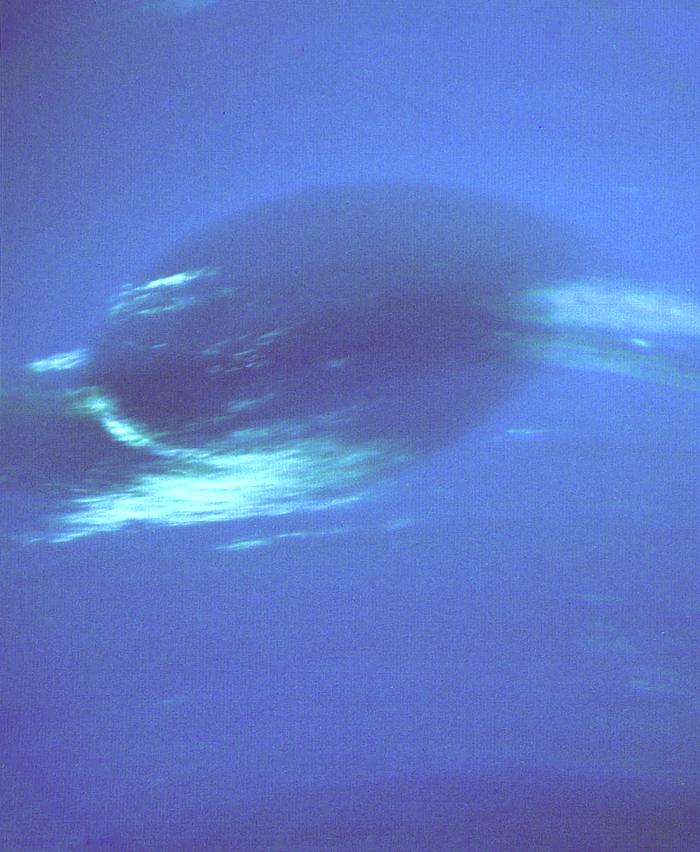
Voyager 2 saw the Great Dark Spot and its bright companion clouds in 1989. Hubble observations years later did not find that same storm, and later dark vortices have appeared and changed. The historic Voyager image below records a real event. No permanent spot is painted onto the representative rotating globe.
Voyager 2 view of the Great Dark Spot · NASA/JPL · Source ↗
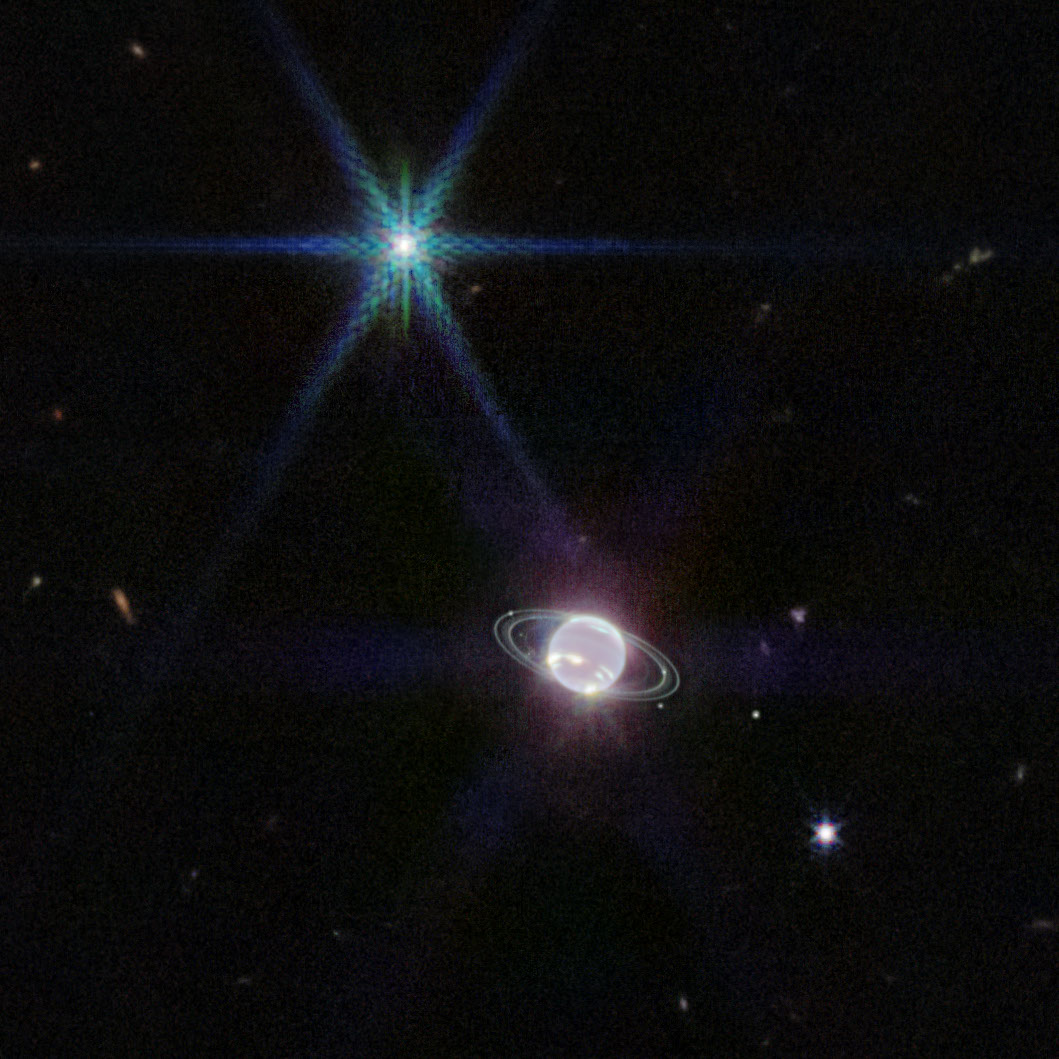
Neptune has a system of narrow, faint rings. Voyager 2 helped establish their structure, and Webb’s near-infrared image brought them into unusually clear view. The thin loops in this 3D scene show that rings exist; their widths, brightness, opacity, and placement are illustrative. The actual Webb observation is shown below, with Triton appearing as the bright point with diffraction spikes.
Webb NIRCam image of Neptune, its rings, and Triton · NASA/ESA/CSA/STScI · Source ↗
Why are Neptune’s auroras far from its geographic poles?
Voyager 2 measured a magnetic field strongly tilted relative to Neptune’s spin. Webb later detected auroral activity at geographic mid-latitudes, consistent with a magnetic geometry unlike Earth’s near-polar lights. Neither field lines nor aurora patches are drawn onto this globe. Laboratory work on superionic ice offers a possible clue about ice-giant interiors, but does not establish Neptune’s exact internal layers.
Triton moves around Neptune opposite to the planet’s rotation, and capture from the Kuiper Belt is the leading explanation. Voyager 2 made the only spacecraft flyby in 1989. This globe uses a Voyager-derived global color map that enhances contrast while remaining close to natural color. It does not animate Triton’s retrograde orbit, and its unobserved terrain remains dark.
What lifted material into Triton’s thin atmosphere?
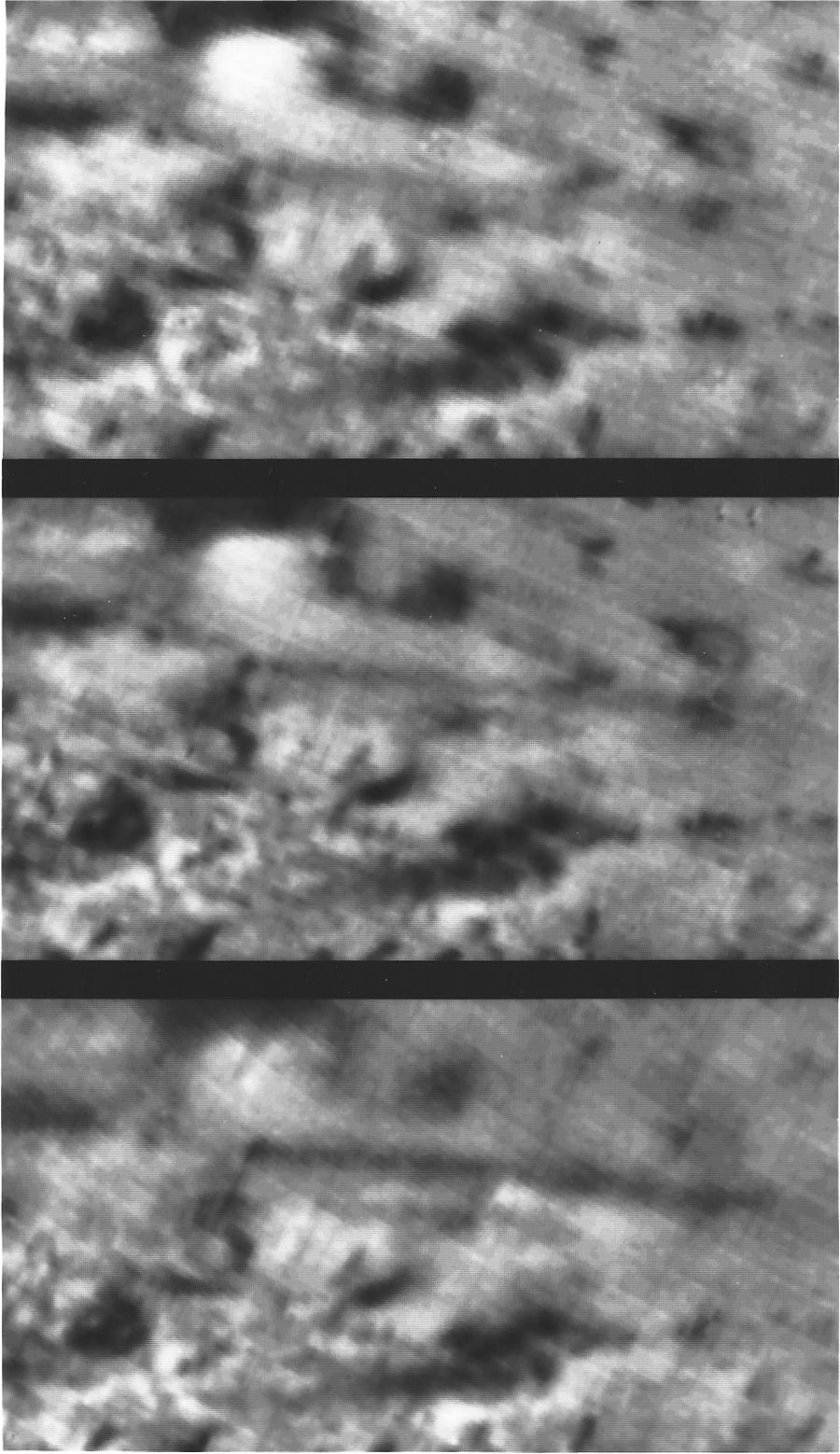
Voyager 2 recorded geyser-like plumes above Triton and dark deposits blown downwind. Sunlight warming nitrogen ice may help drive the eruptions, but the exact mechanism remains a question. The actual sequence below shows a plume in motion over separate exposures. The globe cannot identify a vent at that scale and does not invent an active eruption today.
A single flyby left major gaps in the image record, especially toward the north. In the Triton texture, black regions indicate unobserved terrain rather than a black landscape or permanent darkness. This view tilts toward that pole to show the boundary of the data. The smooth sphere beneath the image is a navigation surface, not a terrain reconstruction.
The Neptune globe uses a fictional, representative cloud texture by Don Davis from NASA/JPL’s 3D resources. It cannot locate the historic Great Dark Spot, a current storm, auroras, or interior layers. The ring loops are illustrative in radius, brightness, and opacity; the separate Webb image is the recorded observation. Triton uses a Voyager-derived color mosaic enhanced for contrast. Its black regions are missing image coverage, not an observed black surface. The smooth sphere does not simulate local relief or active plumes.
An image belongs to an instrument and an encounter.
Voyager-era views and newer telescope observations differ in coverage and measurement method. Colors and surface detail require that context. The viewer helps orient the planets and moons; the linked observations establish what was actually recorded.
Ask yourself How large are the uncertainties, and which claim would go beyond the data?
THE SIGNAL CONTINUES
Some discoveries stay with you.
Get the illustrated investigations delivered to your inbox. Then follow the questions that refuse to leave.